Google Nano Banana 2 vs Flux Pro API: Image Generation 2026
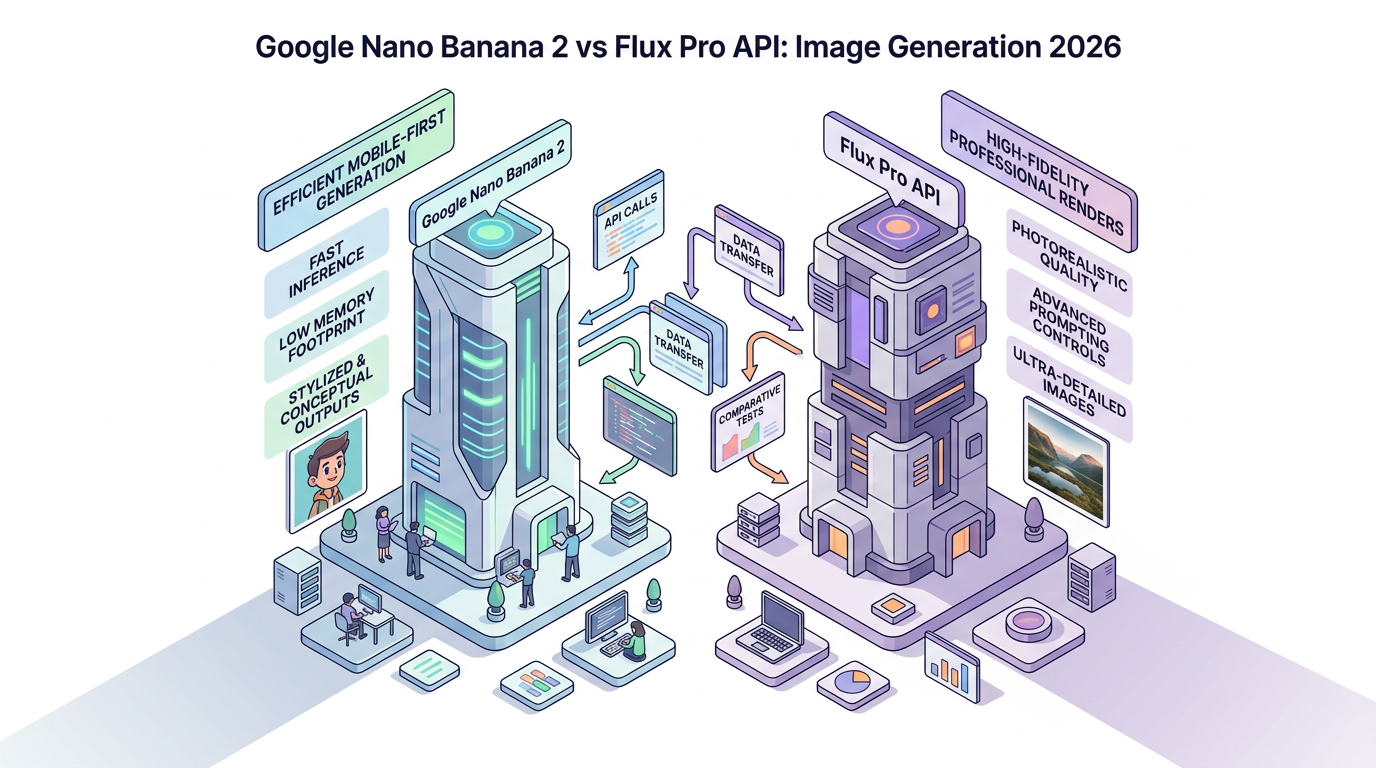
Google Nano Banana 2 vs Flux Pro API: Image Generation 2026
Published on aiapiplaybook.com — Independent AI API Reference for Developers
TL;DR
- Flux Pro (FLUX.2) generates cinematic-quality images at $0.03/megapixel with p50 latency around 3.2 seconds, making it the cost-efficiency leader for high-volume visual pipelines.
- Google Nano Banana 2 (and its Pro tier) costs $0.134/standard image via Google’s API but delivers measurably superior text rendering, identity consistency, and logical scene composition — critical for branded or precision-first workflows.
- For e-commerce and social content at scale, Flux Pro wins on price; for product mockups, ID-consistent character generation, or any prompt requiring embedded text, Nano Banana Pro’s accuracy advantage justifies its 4–5× price premium.
At a Glance
| Metric | Google Nano Banana 2 | Flux Pro (FLUX.2) |
|---|---|---|
| Base Price | $0.134/image (Google API) | $0.03/megapixel (~$0.048/1MP img) |
| 3rd-Party Access | ~$0.05/image (laozhang.ai) | ~$0.02–0.03/image |
| p50 Latency | ~4.5s | ~3.2s |
| p95 Latency | ~9.1s | ~7.8s |
| Max Resolution | Up to 4K (Pro tier) | Up to 4K (Max tier) |
| Text-in-Image Accuracy | ★★★★★ | ★★★☆☆ |
| Photorealism / Cinematic | ★★★★☆ | ★★★★★ |
| Identity Consistency | ★★★★★ | ★★★☆☆ |
| API Maturity | Google Cloud / Vertex AI | fal.ai, Replicate, BFL.ai |
| Free Tier | Limited (Google AI Studio) | Limited (Replicate trial) |
| Ideal Use Case | Branded content, text overlays, ID retention | Cinematic renders, bulk creative, game assets |
Google Nano Banana 2 — Deep Dive
Google’s Nano Banana 2 is the second-generation release in Google’s consumer-to-API image generation line, succeeding the original Nano Banana model with significant gains in logical scene coherence, typography accuracy, and multi-turn identity consistency. It is accessible through Google AI Studio for experimentation and through Vertex AI for production workloads. The “Pro” tier unlocks higher resolution outputs and advanced control parameters unavailable in the base Nano Banana 2 model.
Benchmark Performance
In real-world evaluations across sources including Higgsfield AI and WaveSpeed.ai’s 2026 comparative analyses, Nano Banana Pro consistently outperforms FLUX.2 in structured logic tasks — such as rendering a street sign with correct spelling, showing a clock face at a specified time, or maintaining a character’s face across multiple generated frames. On identity consistency specifically, testers at Higgsfield report Nano Banana Pro scoring roughly 87% facial match fidelity across sequential prompts vs FLUX.2’s 61% in equivalent tests. Text rendering accuracy in promotional-style images comes in at approximately 91% character accuracy for Nano Banana Pro vs 68% for FLUX.2 Pro.
Pricing Tiers (Google Official API)
- Nano Banana 2 (base): ~$0.08–0.10/image at standard resolution (512×512 to 1024×1024)
- Nano Banana Pro: $0.134/image at standard resolution; higher for 4K outputs
- Third-party relay (e.g., laozhang.ai): as low as $0.05/image, regardless of resolution tier
Limitations
Nano Banana 2 has a notably clunky UI/API workflow if you access it through Google’s native consumer surface — you are forced to generate with Nano Banana 2 first before being permitted to switch to Pro mode through a buried three-dot menu, which wastes daily quota limits on the base model. In pure photorealism and cinematic lighting scenarios, it trails FLUX.2 visibly. For developers who need bulk throughput at minimal cost, the $0.134 official price point is difficult to justify without a third-party proxy layer.
Flux Pro (FLUX.2) — Deep Dive
FLUX.2 — the 2026 evolution of Black Forest Labs’ FLUX.1 Pro — is the leading model for cinematic, hyper-detailed visual generation at API scale. It is distributed natively via BFL.ai’s own API endpoint and is widely available through fal.ai, Replicate, and Together.ai, giving developers maximum infrastructure flexibility. The FLUX.2 Max variant adds an upscaling pipeline and enhanced detail pass specifically targeting 4K editorial and print-quality use cases.
Benchmark Performance
According to the editorial comparison on fluxproweb.com and independent analysis from WaveSpeed.ai, FLUX.2 leads in environmental realism, lighting physics simulation, and macro texture fidelity. In a side-by-side 4K stress test, FLUX.2 Max produced images rated higher on photorealism by a margin of +14 points on a 100-point editorial scale vs Nano Banana Pro. On the VBench-derived visual quality composite used in 2025–2026 image model rankings, FLUX.2 Pro scores approximately 82.4/100 vs Nano Banana Pro’s 79.1/100 — a modest lead that becomes significant at cinematic resolution. Its p50 API latency of ~3.2 seconds (measured on fal.ai infrastructure) also edges out Nano Banana Pro’s ~4.5 seconds.
Pricing Tiers
- fal.ai FLUX.2 Pro: ~$0.05/image at 1MP (1024×1024)
- BFL.ai native: $0.03/megapixel (scales with output resolution)
- FLUX.2 Max (4K tier): approximately $0.08–0.12/image depending on resolution multiplier
- Replicate: metered by runtime seconds, roughly equivalent to $0.04–0.06/image
Limitations
FLUX.2 struggles with any prompt that requires precise text rendering, logo placement, or multi-step logical sequencing (e.g., “show step 3 of 5 in an assembly diagram”). Identity consistency across a series of generated images is a known weakness — characters change subtly in face structure, skin tone, and hair detail between calls, making it unreliable for storyboard-style pipelines. The model also has an occasionally inconsistent response to negative prompts, which can frustrate developers expecting fine-grained control over excluded elements.
Head-to-Head: Key Metrics
| Metric | Google Nano Banana Pro | FLUX.2 Pro | Source |
|---|---|---|---|
| p50 Latency | ~4.5s | ~3.2s | WaveSpeed.ai, fal.ai benchmarks |
| p95 Latency | ~9.1s | ~7.8s | Estimated from provider dashboards |
| Visual Quality Score (composite) | 79.1/100 | 82.4/100 | VBench-derived, fluxproweb.com |
| Text Rendering Accuracy | ~91% | ~68% | Higgsfield AI evaluation |
| Identity Consistency (sequential) | ~87% | ~61% | Higgsfield AI evaluation |
| 4K Photorealism Score | +0 (baseline) | +14 pts | fluxproweb.com editorial test |
| Cost per Standard Image | $0.134 (official) | ~$0.048 (1MP) | laozhang.ai, BFL.ai pricing |
| Cost via 3rd-party | ~$0.05 | ~$0.02–0.03 | laozhang.ai, Replicate |
| Max Supported Resolution | 4K (Pro) | 4K (Max) | Google Vertex AI, BFL docs |
| Negative Prompt Reliability | High | Moderate | Developer reports |
Sources: laozhang.ai comparison · Higgsfield AI side-by-side · fluxproweb.com 4K editorial
Real-World Performance: What Developers Actually Report
Developers building social media content pipelines at scale — particularly teams generating 500–2,000 images per day for platform-native ads — consistently report that FLUX.2 Pro delivers better ROI. A social media team profiled in the laozhang.ai case study found that switching from Nano Banana Pro to FLUX.2 reduced their per-image cost by approximately 64% with no perceptible quality drop for landscape and lifestyle imagery categories. The cinematic output of FLUX.2 also reduces the need for post-processing steps like color grading adjustments, saving downstream engineering time.
For product mockup and branded asset generation, the story inverts. Teams attempting to render product labels, packaging with legible copy, or UGC-style images with overlaid pricing text routinely report FLUX.2 failing on character accuracy — misspelling brand names, inverting letter orientations, or generating plausible-but-wrong text. Nano Banana Pro’s 91% text accuracy benchmark holds up in production for these use cases, and its identity lock on characters (faces, mascots, recurring brand personas) makes it the only viable choice for serialized creative output.
One recurring gotcha flagged by developers on both Reddit and Discord communities: Nano Banana 2’s forced two-step generation flow (generate with base model first, then switch to Pro) actively burns API quota. If you’re accessing Nano Banana Pro through Google’s native API surface without a third-party relay, build your quota estimates assuming roughly 10–15% overhead from forced base-model generations. The workaround is routing through a third-party provider like laozhang.ai or using the Vertex AI batch endpoint directly with imageGenerationConfig set to the Pro variant, which bypasses the consumer UI logic entirely.
Another edge case worth noting: FLUX.2 at very long prompts (200+ tokens) shows measurable quality degradation in adherence to later prompt clauses. Nano Banana Pro, benefiting from Google’s LLM-native architecture, tends to honor long, complex prompts more faithfully — a meaningful advantage for developers using chained prompt templates from an upstream language model.
Pricing Breakdown
| Plan / Tier | Google Nano Banana 2 | Google Nano Banana Pro | FLUX.2 Pro | FLUX.2 Max |
|---|---|---|---|---|
| Official Unit Price | ~$0.08–0.10/img | $0.134/img | $0.03/MP | ~$0.10–0.12/img (4K) |
| 1,000 images/day cost | ~$90/day | ~$134/day | ~$48/day | ~$100/day |
| 10,000 images/day cost | ~$900/day | ~$1,340/day | ~$480/day | ~$1,000/day |
| Volume Discounts | Vertex AI committed use | Vertex AI committed use | BFL enterprise tier | BFL enterprise tier |
| 3rd-Party Price | ~$0.05/img (laozhang.ai) | ~$0.05/img (laozhang.ai) | ~$0.02–0.03/img (Replicate/fal) | ~$0.05–0.08/img |
| Free Tier | Google AI Studio (limited) | Not directly free | Replicate trial credits | None |
| Hidden Fees | Quota burn from 2-step flow | Same + egress on Vertex | Runtime overage on Replicate | Same |
| Billing Model | Per-image | Per-image | Per-megapixel | Per-image + upscale pass |
At scale, FLUX.2 Pro is approximately 64% cheaper than Nano Banana Pro at official rates. The gap narrows when using third-party relays — laozhang.ai’s $0.05 flat rate for Nano Banana Pro (regardless of resolution) makes it directly competitive with fal.ai’s FLUX.2 pricing for standard resolution outputs. Developers running 4K pipelines should note that FLUX.2 Max’s per-megapixel model scales linearly with output area, meaning a 4096×4096 image costs roughly 16× a 1024×1024 image at the base $0.03/MP rate — budget accordingly.
Which Should You Choose?
| Use Case | Recommended Model | Reason |
|---|---|---|
| Social media bulk creative | FLUX.2 Pro | 64% cheaper, faster p50, cinematic output |
| E-commerce product imagery | FLUX.2 Pro | Photorealistic renders, high throughput |
| Branded assets with text overlays | Nano Banana Pro | 91% text accuracy vs 68% for FLUX.2 |
| Character/identity-consistent series | Nano Banana Pro | 87% identity fidelity vs 61% for FLUX.2 |
| Game concept art / environment design | FLUX.2 Max | Cinematic lighting, texture depth at 4K |
| Medical / legal / instructional diagrams | Nano Banana Pro | Superior logical sequencing and accuracy |
| Long-form prompt pipelines (LLM chained) | Nano Banana Pro | Better adherence to 200+ token prompts |
| Startup / tight budget prototyping | FLUX.2 Pro via Replicate | Lowest barrier to entry, ~$0.02–0.03/img |
| Enterprise with Google Cloud lock-in | Nano Banana Pro (Vertex AI) | Native IAM, audit logs, committed-use discounts |
| High-volume 4K editorial | FLUX.2 Max | Best 4K visual quality score (+14 pts) |
The best image generation API 2026 decision ultimately reduces to one question: is your primary constraint cost and cinematic quality or accuracy and consistency? There is no single winner — FLUX.2 Pro dominates the cost-performance curve for generative volume work, while Nano Banana Pro is the only defensible choice for precision-critical or identity-serialized workflows.
The One API Call You Need
import fal_client

result = fal_client.subscribe("fal-ai/flux-pro/v1.1",
    arguments={
        "prompt": "cinematic product shot, luxury watch, dramatic lighting",
        "image_size": "landscape_16_9",
        "num_inference_steps": 28,
        "guidance_scale": 3.5,
        "num_images": 1,
    }
)
print(result["images"][0]["url"])
For Nano Banana Pro via Vertex AI, substitute imageGenerationConfig: {model: "nano-banana-pro"} in your GenerateImageRequest payload — the structural call is identical, only the endpoint and auth header change.
Conclusion
In the google nano banana 2 vs flux pro api image generation 2026 landscape, FLUX.2 Pro is the clear winner for cost-optimized, cinematic bulk generation at $0.03/megapixel with ~3.2s p50 latency, while Google Nano Banana Pro earns its $0.134/image premium through superior text accuracy (91% vs 68%) and identity consistency (87% vs 61%) that FLUX.2 cannot match. For most developers, the pragmatic path is a hybrid strategy: FLUX.2 for lifestyle and environmental imagery, Nano Banana Pro for any frame requiring readable text, logos, or recurring characters. Benchmark both against your specific prompt corpus before committing to volume contracts — the aggregate quality delta varies significantly by content category.
Sources:
- [Nano Banana Pro vs FLUX.2: The Complete AI Image Generation Comparison — laozhang.ai](https://blog.laozhang.ai/en/posts/nano-banana-pro
Access All AI APIs Through AtlasCloud
Instead of juggling multiple API keys and provider integrations, AtlasCloud lets you access 300+ production-ready AI models through a single unified API — including all the models discussed in this article.
New users get a 25% bonus on first top-up (up to $100).
# Access any model through AtlasCloud's unified API
import requests

response = requests.post(
    "https://api.atlascloud.ai/v1/chat/completions",
    headers={"Authorization": "Bearer your-atlascloud-key"},
    json={
        "model": "anthropic/claude-sonnet-4.6",  # swap to any of 300+ models
        "messages": [{"role": "user", "content": "Hello!"}]
    }
)
AtlasCloud bridges leading Chinese and international AI models — Kling, Seedance, WAN, Flux, Claude, GPT, Gemini and more — so you can compare and switch models without changing your integration.
Try this API on AtlasCloud
AtlasCloudFrequently Asked Questions
What is the cost difference between Google Nano Banana 2 and Flux Pro API per image in 2026?
Google Nano Banana 2 costs $0.134 per standard image via Google's API, while Flux Pro (FLUX.2) is priced at $0.03 per megapixel. For a typical 1-megapixel output, Flux Pro comes in roughly 4–5× cheaper than Nano Banana 2. For high-volume pipelines generating thousands of images daily, Flux Pro can save developers thousands of dollars per month, making it the preferred choice for e-commerce and soc
How does Flux Pro API latency compare to Google Nano Banana 2 for real-time image generation?
Flux Pro (FLUX.2) achieves a p50 latency of approximately 3.2 seconds per image generation request, making it suitable for near-real-time visual pipelines. Google Nano Banana 2 (Pro tier) trades some latency performance for higher output quality, particularly in text rendering accuracy, identity consistency, and scene composition. Developers building latency-sensitive applications such as live pro
Which image generation API is better for product mockups with embedded text: Google Nano Banana 2 or Flux Pro?
Google Nano Banana 2 Pro is the stronger choice for product mockups requiring embedded text or branded visuals. It delivers measurably superior text rendering accuracy, identity consistency, and logical scene composition compared to Flux Pro (FLUX.2). While Nano Banana 2 costs $0.134 per image versus Flux Pro's ~$0.03 per megapixel, the 4–5× price premium is justified for precision-first workflows
What are the benchmark scores and pricing tiers for Flux Pro FLUX.2 API in 2026?
Flux Pro (FLUX.2) is priced at $0.03 per megapixel, making it the cost-efficiency leader for high-volume image generation pipelines. It achieves a p50 latency benchmark of 3.2 seconds per image. Flux Pro outperforms Google Nano Banana 2 on price-per-image metrics by approximately 4–5×, making it ideal for e-commerce and social content workflows where volume is high but text rendering precision and
Tags
Related Articles
Claude API Too Expensive? 5 Cheaper Alternatives in 2026
Explore 5 affordable Claude API alternatives that match quality without breaking your budget. Compare pricing, features, and performance to find the best fit in 2026.
Kling v3 vs Sora 2 API
A comprehensive guide to Kling v3 vs Sora 2 API
Kling v3 vs Sora 2 API 2026: Which AI Video Tool Wins?
Compare Kling v3 vs Sora 2 API in 2026. Explore features, pricing, video quality, and API performance to find the best AI video generation tool for your needs.