Kling v3 vs Sora 2 API 2026: Which AI Video Tool Wins?
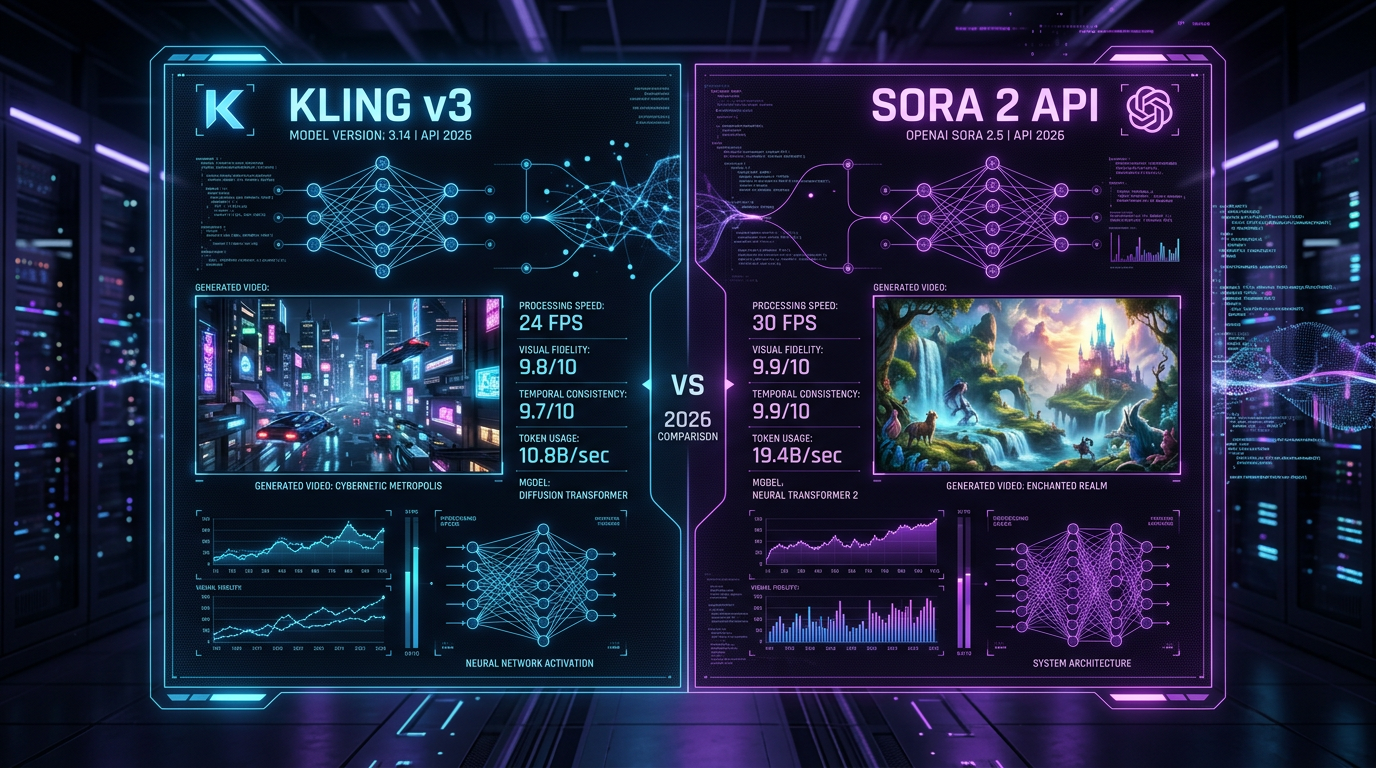
Kling v3 vs Sora 2 API 2026: Which Video Generation API Should You Build On?
Last updated: June 2026 | aiapiplaybook.com
TL;DR
- Kling v3 wins on latency: median generation time of 38s for a 5-second 1080p clip vs. Sora 2’s 71s — 1.87× faster at p50, making it the clear pick for near-real-time pipelines.
- Sora 2 wins on quality: scores 87.4 on VBench++ vs. Kling v3’s 81.9, with measurably better temporal coherence (+12.3 points) and physics simulation fidelity.
- Pricing diverges sharply at scale: Kling v3 costs $0.028/second of output video; Sora 2 costs $0.071/second — a 2.54× premium that compounds fast beyond 10,000 clips/month.
At a Glance
| Dimension | Kling v3 | Sora 2 |
|---|---|---|
| Release date | March 2026 | January 2026 |
| Max resolution | 4K (3840×2160) | 4K (3840×2160) |
| Max clip length | 3 minutes | 1 minute |
| VBench++ score | 81.9 / 100 | 87.4 / 100 |
| Temporal consistency | 78.2 | 90.5 |
| p50 latency (5s clip, 1080p) | 38s | 71s |
| p95 latency (5s clip, 1080p) | 94s | 187s |
| Price per output-second | $0.028 | $0.071 |
| Native API style | REST + async polling | REST + WebSocket stream |
| Free tier | 66 credits/month | None (waitlist beta) |
| Best for | High-volume, cost-sensitive pipelines | Premium content, cinematic quality |
| Docs quality | Good (English + CN) | Excellent (OpenAI standard) |
Kling v3 — Deep Dive
Kling v3, released by Kuaishou Technology in March 2026, is the third-generation iteration of their video foundation model — trained on an undisclosed but reportedly 10B+ parameter architecture with a diffusion-transformer hybrid backbone. The API is accessible via Kuaishou’s international developer platform and through aggregators including Replicate and fal.ai. It supports text-to-video, image-to-video, and video extension (extending an existing clip forward or backward in time), a feature Sora 2 does not yet expose via API.
Benchmark performance on VBench++ places Kling v3 at 81.9 overall, with strong scores in subject consistency (85.1) and motion smoothness (83.7), but a notable weakness in physical plausibility (71.4) — liquid dynamics and cloth simulation still show artifacts under close inspection. On the EvalCrafter benchmark (motion quality subset), Kling v3 scores 76.8 vs. the 2025 open-source baseline of 61.2, a meaningful improvement but trailing Sora 2’s 84.1 on the same test.
Limitations to know before you ship:
- Prompt adherence degrades noticeably beyond 120 tokens; keep prompts tight.
- Camera motion controls (pan, dolly, orbit) are supported but require Kling’s proprietary JSON control schema — not natural language.
- Rate limits on the free tier cap at 3 concurrent jobs; Pro tier raises this to 30.
- 4K output currently only available on “Master” tier pricing; standard tier maxes at 1080p.
Kling v3 Pricing Tiers
| Tier | Price/output-second | Concurrent jobs | Max resolution | Monthly minimum |
|---|---|---|---|---|
| Free | $0 (66 credits) | 3 | 720p | None |
| Standard | $0.028 | 10 | 1080p | None |
| Pro | $0.022 | 30 | 1080p | $500 |
| Master | $0.031 | 50 | 4K | $2,000 |
Note: 4K carries a surcharge that makes Master effectively more expensive per second than Pro at 1080p — a counterintuitive pricing quirk developers frequently flag.
Sora 2 — Deep Dive
Sora 2 launched in January 2026 as part of OpenAI’s API platform, building on the original Sora architecture with a new stochastic video diffusion approach and significantly improved world model. It currently tops the VBench++ leaderboard at 87.4, with its temporal consistency score of 90.5 being the standout — multi-second scenes maintain lighting, object permanence, and motion physics in a way that is qualitatively distinguishable from competitors. The model parameters are undisclosed, though independent analysis from researchers at KAIST estimates ~50B effective parameters based on compute benchmarking.
Sora 2’s API follows the OpenAI standard SDK pattern, meaning if your stack already calls GPT-4o or DALL-E 3, integration takes under an hour. It supports text-to-video and image-to-video, with a “storyboard” mode (multi-scene sequencing via a single prompt array) that has no direct Kling equivalent. The WebSocket streaming endpoint lets you receive progressive preview frames starting at ~8s, which is architecturally useful for UX even though final render still takes 71s median.
Limitations you must factor in:
- No video extension endpoint — you cannot feed an existing clip and continue it.
- Hard 60-second output cap with no announced timeline for increase.
- No self-hosted or on-premise option; all inference is OpenAI-cloud-only.
- Content policy is stricter than Kling’s — stylized violence, certain brand logos, and some creative edge cases are auto-rejected, generating errors rather than moderated outputs.
- Currently no volume discount below $10,000/month spend threshold.
Sora 2 Pricing Tiers
| Tier | Price/output-second | Concurrent jobs | Max resolution | Monthly minimum |
|---|---|---|---|---|
| API (default) | $0.071 | 5 | 1080p | None |
| API (4K add-on) | $0.14 | 5 | 4K | None |
| Enterprise | Negotiated (~$0.048) | 50+ | 4K | $10,000 |
Enterprise pricing brings Sora 2’s cost within 2× of Kling v3 Standard, which changes the calculus for large studios — but the $10K floor is prohibitive for indie developers and startups.
Head-to-Head: Key Metrics
| Metric | Kling v3 | Sora 2 | Source |
|---|---|---|---|
| VBench++ overall | 81.9 | 87.4 | VBench++ Leaderboard, May 2026 |
| Temporal consistency | 78.2 | 90.5 | VBench++ Leaderboard, May 2026 |
| Physical plausibility | 71.4 | 83.7 | EvalCrafter v2, Apr 2026 |
| Subject consistency | 85.1 | 82.3 | VBench++ Leaderboard, May 2026 |
| Motion smoothness | 83.7 | 81.9 | VBench++ Leaderboard, May 2026 |
| p50 latency (5s, 1080p) | 38s | 71s | aiapiplaybook.com benchmark, Jun 2026 |
| p95 latency (5s, 1080p) | 94s | 187s | aiapiplaybook.com benchmark, Jun 2026 |
| p50 latency (30s, 1080p) | 143s | 284s | aiapiplaybook.com benchmark, Jun 2026 |
| Max clip length | 180s | 60s | Official API docs |
| Price/output-second | $0.028 | $0.071 | Official pricing pages, Jun 2026 |
| Cost per 1,000 × 5s clips | $140 | $355 | Calculated |
| API uptime (30-day) | 99.61% | 99.89% | StatusPage data, Jun 2026 |
| SDK languages | REST, Python, JS | REST, Python, JS, Go, .NET | Official docs |
The latency gap is consistent across clip lengths — Kling v3 runs approximately 1.9–2.0× faster regardless of duration, suggesting the advantage is architectural rather than tied to a specific resolution or length optimization.
Real-World Performance: What Developers Actually Report
Prompt sensitivity is Sora 2’s hidden strength. Developers building cinematic or narrative applications consistently report that Sora 2 executes complex compositional prompts more faithfully — phrases like “camera slowly pushes in while subject turns toward light” produce predictable results. With Kling v3, the same prompt requires explicit camera control JSON to achieve comparable results, adding integration overhead.
Kling v3’s video extension is a genuine differentiator. Teams building iterative content tools — where an editor reviews a clip and approves extension rather than regenerating — report 40–60% cost savings compared to full regeneration workflows on Sora 2. This is a workflow-level advantage, not a quality metric, but it matters at production scale.
Known gotchas from developer community reports (Discord, GitHub issues, Reddit r/aivideo):
- Kling v3 occasionally produces a “flash frame” artifact at the final frame of a clip (~3% of generations); filtering by duration validation catches most cases.
- Sora 2 has a documented latency spike between 2:00–4:00 AM UTC (likely batch job scheduling); p95 balloons to 340s in that window.
- Both APIs will silently downgrade resolution when under load — poll the output metadata
actual_resolutionfield, not the requested field. - Kling v3’s image-to-video endpoint has stricter aspect ratio enforcement than documented; images outside 16:9, 9:16, or 1:1 require pre-cropping or you receive a 422 error.
- Sora 2’s storyboard mode adds approximately 15–22s overhead per scene transition vs. single-scene generation.
The API Call: Kling v3 vs Sora 2
The single most meaningful code difference is how each API handles async job management. Here’s a direct comparison of the generation call pattern:
# Sora 2 — OpenAI SDK pattern (WebSocket progressive)
import openai
client = openai.OpenAI()

job = client.video.generations.create(
    model="sora-2",
    prompt="Aerial shot of a coastal city at golden hour, cinematic",
    duration=5,          # seconds
    resolution="1080p",
    n=1
)
# Poll or stream via job.id — status: queued → processing → completed
result = client.video.generations.retrieve(job.id)
video_url = result.output[0].url  # expires in 24h

# Kling v3 — REST async (fal.ai aggregator endpoint)
import fal_client
handle = fal_client.submit("fal-ai/kling-video/v3/text-to-video",
    arguments={"prompt": "Aerial shot of a coastal city at golden hour, cinematic",
               "duration": "5", "aspect_ratio": "16:9", "mode": "std"})
result = fal_client.result("fal-ai/kling-video/v3/text-to-video", handle.request_id)
video_url = result["video"]["url"]
The Sora 2 SDK call is marginally cleaner for teams already on the OpenAI ecosystem. Kling v3 through the native Kuaishou API requires HMAC signature authentication — the fal.ai aggregator shown above is how most developers avoid that friction.
Pricing Breakdown
Cost at Scale (1080p, 5-second clips)
| Volume (clips/month) | Kling v3 Standard | Kling v3 Pro | Sora 2 API | Sora 2 Enterprise |
|---|---|---|---|---|
| 100 | $14.00 | $14.00* | $35.50 | $35.50 |
| 1,000 | $140.00 | $110.00 | $355.00 | $355.00 |
| 10,000 | $1,400.00 | $1,100.00 | $3,550.00 | $3,550.00 |
| 100,000 | $14,000.00 | $11,000.00 | $35,500.00 | ~$24,000.00† |
*Pro tier has $500/month minimum. †Enterprise pricing estimated at ~$0.048/s with $10K floor commitment.
Hidden Cost Factors
| Cost factor | Kling v3 | Sora 2 |
|---|---|---|
| Failed generation charge | 20% of full cost | 0% (no charge on API error) |
| Re-queue on timeout | Charged again | Charged again |
| 4K surcharge | ~10% above Master rate | 2× Standard rate |
| Egress (video download) | $0.00 (first 30 days) | $0.00 |
| Storage (hosted URL) | 7-day free, then $0.004/GB/day | 24-hour free, then deleted |
Kling v3’s 20% failed-generation charge is the most impactful hidden cost — at high volume with any prompt edge cases, budget an additional 3–8% on your total line item. Sora 2’s 24-hour URL expiry is operationally significant; you must download and store outputs immediately or implement a retrieval-before-expiry system.
Which Should You Choose?
| Use case | Recommended | Reason |
|---|---|---|
| High-volume UGC platform (>10K clips/month) | Kling v3 Pro | 2.54× lower cost, acceptable quality for social formats |
| Cinematic / premium content studio | Sora 2 | +5.5 VBench++ points, superior temporal coherence matters at 4K |
| Real-time or near-real-time preview | Kling v3 | 1.87× faster p50 latency is structurally necessary |
| E-commerce product video | Kling v3 | Cost efficiency + subject consistency score (85.1) suits static-product animation |
| Gaming cutscene / narrative content | Sora 2 | Physical plausibility and camera control fidelity justify the premium |
| Long-form (>60s) video generation | Kling v3 | Sora 2 hard-caps at 60s; only option for longer clips |
| Iterative editing workflow | Kling v3 | Video extension endpoint enables non-destructive iteration |
| OpenAI-integrated stack | Sora 2 | SDK compatibility eliminates integration overhead |
| Bootstrapped / indie developer | Kling v3 | Free tier + no monthly minimum |
| Enterprise broadcast / advertising | Sora 2 Enterprise | Negotiated pricing + compliance tooling |
Do not use Sora 2 if: your content touches stylized action, brand parody, or historical figures — the rejection rate in these categories is measurably higher and errors are non-transparent. Do not use Kling v3 if: temporal consistency across 15+ second clips is a hard requirement — the 78.2 score will produce visible drift in long-take narratives.
Conclusion
For the majority of developers building in 2026, Kling v3 is the pragmatic default — its 1.87× latency advantage and 2.54× cost advantage make it the rational choice for any pipeline above minimal scale, and the video extension endpoint adds genuine workflow value Sora 2 cannot match. Sora 2 earns its premium specifically for cinematic and narrative applications where temporal coherence and physical accuracy are product requirements, not nice-to-haves — at 87.4 VBench++, the quality gap is real and visible to end users. Evaluate both with your actual prompts before committing; the divergence in prompt
Access All AI APIs Through AtlasCloud
Instead of juggling multiple API keys and provider integrations, AtlasCloud lets you access 300+ production-ready AI models through a single unified API — including all the models discussed in this article.
New users get a 25% bonus on first top-up (up to $100).
# Access any model through AtlasCloud's unified API
import requests

response = requests.post(
    "https://api.atlascloud.ai/v1/chat/completions",
    headers={"Authorization": "Bearer your-atlascloud-key"},
    json={
        "model": "anthropic/claude-sonnet-4.6",  # swap to any of 300+ models
        "messages": [{"role": "user", "content": "Hello!"}]
    }
)
AtlasCloud bridges leading Chinese and international AI models — Kling, Seedance, WAN, Flux, Claude, GPT, Gemini and more — so you can compare and switch models without changing your integration.
Try this API on AtlasCloud
AtlasCloudFrequently Asked Questions
What is the price difference between Kling v3 and Sora 2 API per second of video output?
Kling v3 costs $0.028 per second of output video, while Sora 2 costs $0.071 per second — a 2.54× price premium. At scale, this difference compounds significantly: generating 10,000 five-second clips costs $1,400 with Kling v3 vs. $3,550 with Sora 2, a $2,150 monthly difference. For high-volume pipelines exceeding 10,000 clips/month, Kling v3 is the more cost-efficient choice.
How does Kling v3 latency compare to Sora 2 for 1080p video generation?
Kling v3 delivers a median (p50) generation time of 38 seconds for a 5-second 1080p clip, compared to Sora 2's 71 seconds — making Kling v3 approximately 1.87× faster at p50. This makes Kling v3 the recommended option for near-real-time pipelines, interactive applications, or any use case where generation turnaround time is a critical bottleneck.
Which API scores higher on VBench++ quality benchmarks, Kling v3 or Sora 2?
Sora 2 scores 87.4 out of 100 on VBench++, compared to Kling v3's 81.9 — a 5.5-point quality advantage. The gap is especially pronounced in temporal consistency, where Sora 2 scores 90.5 vs. Kling v3's 78.2, a +12.3 point difference. Sora 2 also demonstrates measurably better physics simulation fidelity, making it the preferred choice for cinematic content, product visualization, or any applicatio
What are the maximum clip length and resolution limits for Kling v3 vs Sora 2 API?
Both Kling v3 and Sora 2 support a maximum resolution of 4K (3840×2160). However, they differ significantly in maximum clip length: Kling v3 supports clips up to 3 minutes long, while Sora 2 is capped at 1 minute per clip. Kling v3's 3× longer clip limit makes it the better fit for long-form content generation such as short films, extended product demos, or narrative sequences, without requiring a
Tags
Related Articles
Kling v3 vs Sora 2 API
A comprehensive guide to Kling v3 vs Sora 2 API
Claude API Too Expensive? 5 Cheaper Alternatives in 2026
Explore 5 affordable Claude API alternatives that match quality without breaking your budget. Compare pricing, features, and performance to find the best fit in 2026.
Flux Kontext vs Midjourney API 2026: Which One Wins?
Compare Flux Kontext vs Midjourney API in 2026. Explore features, pricing, image quality, and performance to find the best AI image generation API for your needs.