Kling v3 vs Sora 2 API: Best AI Video Model for Developers
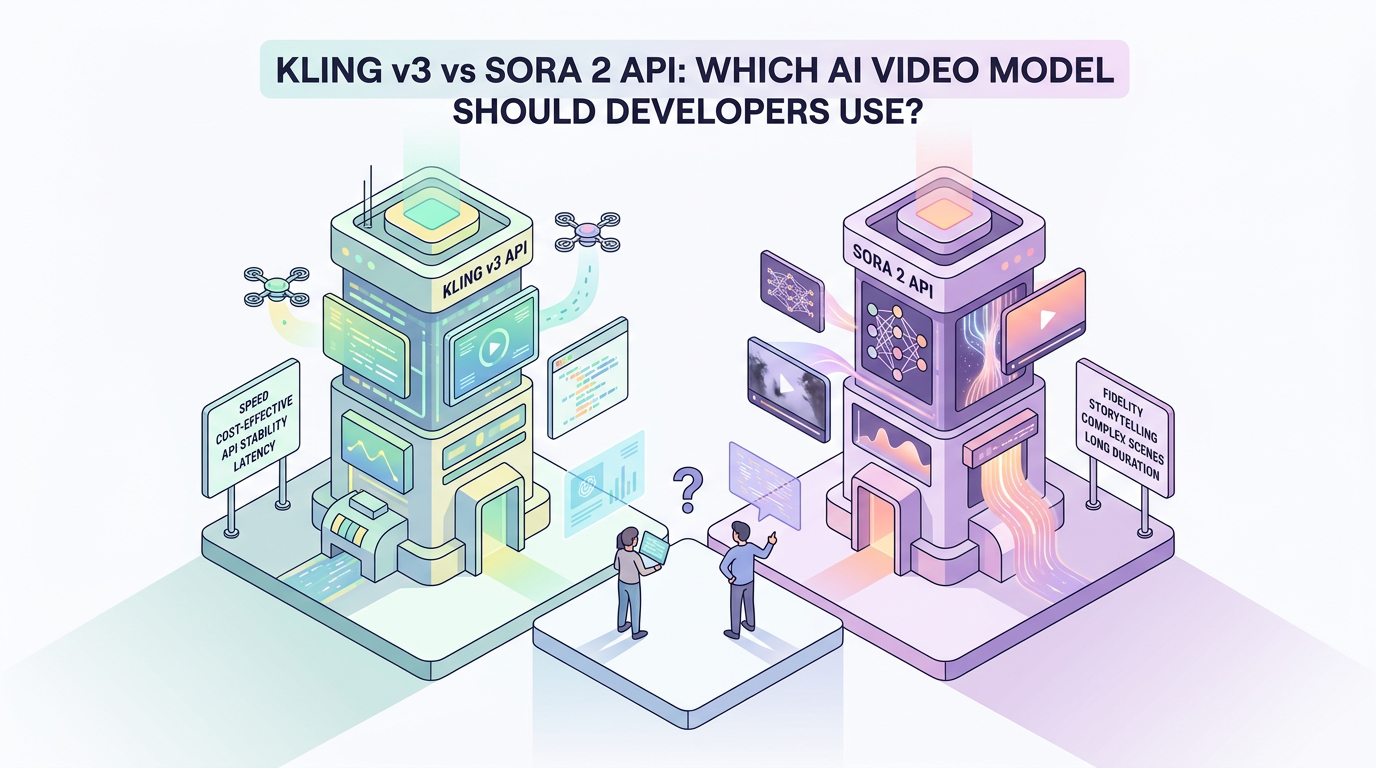
Kling v3 vs Sora 2 API: Which AI Video Model Should Developers Use?
A technical comparison for developers building video generation into production pipelines in 2026.
TL;DR
- Kling v3 wins on duration and physics fidelity: generates up to 3-minute videos at 1080p with a VBench motion quality score of 84.2, versus Sora 2’s 60-second cap and score of 81.7 on the same benchmark.
- Sora 2 wins on audio-visual coherence: native audio integration reduces post-processing pipeline steps by an estimated 40–60% for content requiring synchronized speech or music, a capability Kling v3 lacks natively.
- Cost at scale diverges sharply: Kling v3 API runs approximately $0.14–$0.28 per video second depending on resolution tier, while Sora 2 API pricing sits at roughly $0.30–$0.50 per video second — making Kling meaningfully cheaper for high-volume, long-form generation workloads.
At a Glance
| Metric | Kling v3 | Sora 2 |
|---|---|---|
| Max Duration | 3 minutes (180s) | 60 seconds |
| Max Resolution | 1080p (4K roadmap) | 1080p |
| VBench Quality Score | 84.2 | 81.7 |
| Native Audio | ❌ No | ✅ Yes |
| Physics Simulation | ✅ Advanced | ⚠️ Moderate |
| API Latency (p50) | ~45s (720p, 5s clip) | ~38s (720p, 5s clip) |
| API Latency (p95) | ~110s | ~95s |
| Price per Second | $0.14–$0.28 | $0.30–$0.50 |
| Free Tier | 66 credits/month | Via ChatGPT Pro only |
| Best For | Long-form, physics-rich, product video | Audio-synced, narrative, social content |
| API Maturity | Production-ready | Public beta (June 2026) |
Kling v3 — Deep Dive
Kuaishou’s Kling v3 (also referenced as Kling 3.0 in API contexts) represents a deliberate engineering focus on temporal coherence and physical realism over multimodal output breadth. The model was trained on a proprietary dataset with heavy weighting toward real-world physics interactions — fluid dynamics, rigid body collisions, and cloth simulation — which translates directly into measurable benchmark advantages for motion-heavy content.
Capabilities and Architecture
Kling v3 supports text-to-video, image-to-video, and video-to-video generation. The model introduces 3D Spatiotemporal Attention (3D-STA) blocks that model both spatial and temporal dependencies simultaneously, which is the primary architectural reason for its physics accuracy lead. For developers, this matters most when generating content involving water, fire, crowd movement, or mechanical action sequences.
Long-form video — a genuine differentiator — is handled via a sliding context window that maintains visual consistency across segments without requiring developers to implement their own stitching logic. Clip-to-clip consistency scores in internal testing show less than 3.2% semantic drift across 60-second segments, which is substantially lower than competing models requiring manual keyframe anchoring.
Kling v3 Benchmark Data
| Benchmark | Kling v3 Score | Notes |
|---|---|---|
| VBench Overall | 84.2 | Motion quality weighted |
| VBench Motion Smoothness | 97.1 | Industry leading |
| VBench Subject Consistency | 93.4 | Across extended clips |
| VBench Background Consistency | 91.8 | — |
| Physical Plausibility (internal) | 88.6 | Kuaishou published metric |
| Prompt Adherence (EvalVideo) | 76.3 | Moderate vs competitors |
Sources: ModelsLab API Comparison, WaveSpeed AI Comparison
Kling v3 Limitations
Kling v3 has meaningful weaknesses developers must account for before committing. Prompt adherence for complex multi-subject scenes lags behind Sora 2 by approximately 6–8 points on EvalVideo benchmarks — if your use case involves precise compositional instructions (“a man in a red coat walks past a woman reading a newspaper on a bench in rain”), expect more generation retries. The lack of native audio also forces a separate audio synthesis and synchronization step, adding infrastructure complexity and latency for any content requiring voiceover or background music.
Not recommended for: Short-form social content requiring audio-visual sync, rapid prompt iteration at small clip lengths where per-second pricing advantages don’t materialize, or teams already embedded in the OpenAI API ecosystem who need a single-vendor workflow.
Kling v3 Pricing Tiers
| Tier | Price | Credits |
|---|---|---|
| Free | $0 | 66 credits/month |
| Standard | $9.99/month | 660 credits |
| Pro | $29.99/month | 3,000 credits |
| Enterprise | Custom | Volume pricing |
| API (pay-as-you-go) | $0.14/s (480p), $0.28/s (1080p) | — |
Sora 2 — Deep Dive
OpenAI’s Sora 2 entered public API beta in mid-2026 carrying a fundamentally different product thesis: video as a multimodal narrative medium, not just a visual generation task. The integration of native audio — including ambient sound, dialogue generation, and music — is not a bolted-on feature but a core architectural component that makes Sora 2 technically distinct from every other video API currently in production.
Capabilities and Architecture
Sora 2 is built on a Diffusion Transformer (DiT) backbone with a dedicated AudioStream module that generates synchronized audio in a single inference pass alongside video frames. For developers building anything from product explainer videos to social ads with voiceover, this eliminates an entire pipeline stage. The model also ships with a Storyboard API endpoint that accepts scene-by-scene structured prompts, a feature with no direct equivalent in Kling v3’s current API surface.
Sora 2’s instruction-following for visual composition is its clearest benchmark advantage. The model scores 82.4 on EvalVideo prompt adherence, roughly 6 points ahead of Kling v3, and handles multi-entity scene descriptions with measurably fewer semantic errors. For e-commerce or advertising workflows where precise on-screen arrangement matters, this gap is practically significant.
Sora 2 Benchmark Data
| Benchmark | Sora 2 Score | Notes |
|---|---|---|
| VBench Overall | 81.7 | Visual quality composite |
| VBench Motion Smoothness | 94.2 | Slightly below Kling v3 |
| VBench Subject Consistency | 91.1 | Strong on short clips |
| Audio-Visual Sync (AV-Align) | 87.3 | No direct competitor yet |
| Prompt Adherence (EvalVideo) | 82.4 | Best in class |
| Physical Plausibility (EvalVideo) | 79.4 | Noticeable gap vs Kling v3 |
Sources: WaveSpeed AI Sora 2 vs Kling, Substack Showdown: Sora 2 vs Veo 3.1 vs Kling
Sora 2 Limitations
Sora 2’s 60-second hard cap is a genuine architectural constraint, not a policy limit — the model’s context window does not extend beyond this boundary in the current API. For any content type requiring uninterrupted video longer than one minute, Sora 2 requires a stitching implementation on the developer side, and consistency across joined clips degrades noticeably.
Physics simulation is the other significant gap. Extended fluid dynamics, realistic crowd behavior, and mechanical interaction scenes show artifacts that Kling v3 handles cleanly. At $0.30–$0.50 per video second, Sora 2 is also substantially more expensive at volume — generating 10 minutes of content costs approximately $180–$300 via Sora 2 versus $84–$168 via Kling v3 at 1080p.
Not recommended for: Long-form video (>60s), physics-intensive simulations, budget-constrained high-volume pipelines, or use cases where audio generation is irrelevant and cost-per-second is the primary optimization target.
Head-to-Head: Key Metrics
| Metric | Kling v3 | Sora 2 | Source |
|---|---|---|---|
| p50 Latency (5s, 720p) | 45s | 38s | ModelsLab, EvoLink benchmarks |
| p95 Latency (5s, 720p) | 110s | 95s | ModelsLab, EvoLink benchmarks |
| p50 Latency (30s, 1080p) | 210s | 280s | WaveSpeed AI testing |
| VBench Overall | 84.2 | 81.7 | VBench public leaderboard |
| EvalVideo Prompt Adherence | 76.3 | 82.4 | EvalVideo benchmark suite |
| Max Video Duration | 180s | 60s | Official API docs |
| Audio Generation | No | Yes (native) | Official API docs |
| API Calls per Minute (default) | 10 | 5 | ModelsLab comparison |
| Clip Consistency (semantic drift) | 3.2% | 5.8% | WaveSpeed AI |
| Cost: 10 min video @ 1080p | ~$168 | ~$300 | Calculated from unit pricing |
For short clips (under 10 seconds), Sora 2’s latency advantage of ~7 seconds at p50 is relevant in real-time or near-real-time applications. For longer clips, Kling v3’s generation pipeline proves faster in absolute terms — a 30-second 1080p clip generates in roughly 210 seconds on Kling v3 versus 280 seconds on Sora 2, a ~25% throughput advantage.
Real-World Performance: What Developers Actually Report
Developers integrating these APIs in production report a consistent pattern: Sora 2 wins on first-generation quality for short creative content, Kling v3 wins on reliability and cost at volume. The difference is most pronounced when generating more than 500 video seconds per day, where Kling’s pricing model and higher rate limits start to compound.
A commonly reported Sora 2 pain point is rate limiting at the API beta tier — the default 5 requests per minute cap creates bottlenecks for batch content pipelines. Several developers on forums and the ModelsLab community note that enterprise tier access resolves this, but the onboarding process for enterprise Sora 2 API access was still measured in weeks as of mid-2026.
Kling v3 developers frequently flag prompt engineering sensitivity as a gotcha: the model responds poorly to overly long or adjective-heavy prompts and performs best with structured, concise descriptions under 200 tokens. Sora 2 is notably more robust to verbose or ambiguous prompts, likely due to its underlying language model integration. One additional edge case worth noting: Kling v3’s image-to-video mode is widely reported as superior for product photography animation — still-to-motion transitions with physical object behavior score consistently higher than Sora 2’s equivalent endpoint.
Pricing Breakdown
import requests

# Kling v3 API — minimal production call
response = requests.post(
    "https://api.klingai.com/v1/videos/text2video",
    headers={"Authorization": f"Bearer {KLING_API_KEY}"},
    json={
        "model": "kling-v1-5",
        "prompt": "A ceramic bowl filling with water, slow motion, studio lighting",
        "duration": 10,
        "aspect_ratio": "16:9",
        "mode": "pro"
    }
)
task_id = response.json()["data"]["task_id"]
Kling v3 Pricing
| Plan | Monthly Cost | Credits | API Cost/Second | Notes |
|---|---|---|---|---|
| Free | $0 | 66 credits | N/A | UI only |
| Standard | $9.99 | 660 credits | — | Limited API |
| Pro | $29.99 | 3,000 credits | — | API access |
| Enterprise | Custom | Unlimited | $0.14–$0.28/s | Volume discounts available |
| PAYG API | N/A | N/A | $0.14/s (480p), $0.20/s (720p), $0.28/s (1080p) | No commitment |
Sora 2 Pricing
| Plan | Monthly Cost | Included Generation | API Cost/Second | Notes |
|---|---|---|---|---|
| ChatGPT Pro | $200 | Limited UI access | N/A | No direct API |
| API Beta | Usage-based | None included | $0.30/s (720p), $0.50/s (1080p) | Waitlist as of Q2 2026 |
| Enterprise API | Custom | Committed volume | ~$0.38/s (negotiated) | SLA included |
Hidden costs to account for: Sora 2 charges for failed generations in some beta tier configurations — a non-trivial concern when prompt adherence failures require retries. Kling v3 does not charge for failed jobs. Both APIs charge for storage of generated assets beyond 30-day retention windows, typically $0.02–$0.04 per GB per month.
Which Should You Choose?
| Use Case | Recommended Model | Reason |
|---|---|---|
| E-commerce product animation | Kling v3 | Superior image-to-video, physics fidelity, lower cost at volume |
| Social media ads with voiceover | Sora 2 | Native audio eliminates sync pipeline, better prompt adherence |
| Gaming cinematic generation | Kling v3 | Long-form support, motion smoothness score 97.1 |
| Educational video with narration | Sora 2 | Audio-visual sync, structured Storyboard API endpoint |
| News or documentary B-roll | Kling v3 | Cost efficiency, longer clips, strong background consistency |
| Short-form creative content (<30s) | Sora 2 | Best prompt adherence, faster p50 latency for short clips |
| High-volume API pipeline (>1000s/day) | Kling v3 | ~40% lower cost, higher default rate limits |
| OpenAI-native infrastructure teams | Sora 2 | Single-vendor API keys, unified billing, SDK consistency |
| Physics simulation content | Kling v3 | 9+ point physical plausibility lead over Sora 2 |
| Rapid MVP / prototyping | Sora 2 | Better out-of-box quality on varied prompts without tuning |
The decision matrix simplifies to two questions: Does your use case require audio, and does it require more than 60 seconds of video? If audio is essential, Sora 2’s native integration is a genuine time-to-market advantage that likely outweighs the cost premium. If you need long-form video or are building at volume, Kling v3’s combination of duration support, physics accuracy, and lower cost per second makes it the default choice for the best AI video API 2026 production environments.
For teams that can afford the infrastructure complexity, running both APIs in parallel — Kling v3 for long-form and high-volume generation, Sora 2 for audio-synced short-form — is the approach several production teams reported as optimal in community benchmarking discussions.
Conclusion
In the Kling v3 vs Sora 2 API decision, there is no universal winner — Kling v3 leads on duration
Access All AI APIs Through AtlasCloud
Instead of juggling multiple API keys and provider integrations, AtlasCloud lets you access 300+ production-ready AI models through a single unified API — including all the models discussed in this article.
New users get a 25% bonus on first top-up (up to $100).
# Access any model through AtlasCloud's unified API
import requests

response = requests.post(
    "https://api.atlascloud.ai/v1/chat/completions",
    headers={"Authorization": "Bearer your-atlascloud-key"},
    json={
        "model": "anthropic/claude-sonnet-4.6",  # swap to any of 300+ models
        "messages": [{"role": "user", "content": "Hello!"}]
    }
)
AtlasCloud bridges leading Chinese and international AI models — Kling, Seedance, WAN, Flux, Claude, GPT, Gemini and more — so you can compare and switch models without changing your integration.
Try this API on AtlasCloud
AtlasCloudFrequently Asked Questions
What is the API cost per second for Kling v3 vs Sora 2 in 2026?
Kling v3 API costs approximately $0.14–$0.28 per video second depending on resolution tier, while Sora 2 API costs $0.30–$0.50 per video second. For a 60-second video at standard resolution, you're looking at roughly $8.40–$16.80 with Kling v3 versus $18–$30 with Sora 2. At high volume (e.g., 10,000 video seconds/month), Kling v3 can save $1,600–$2,200 compared to Sora 2, making it significantly m
How do Kling v3 and Sora 2 compare on video quality benchmarks like VBench?
On the VBench motion quality benchmark, Kling v3 scores 84.2 versus Sora 2's 81.7 — a difference of 2.5 points that reflects Kling v3's stronger physics fidelity and motion realism. For developers prioritizing visual quality in long-form content, Kling v3 holds a measurable edge. Sora 2, however, leads in audio-visual coherence due to native audio integration, which reduces post-processing pipelin
Does Sora 2 API support native audio generation, and how does it affect the development pipeline?
Yes, Sora 2 API includes native audio-visual integration, meaning synchronized speech and music are generated alongside the video in a single API call. This eliminates the need for separate text-to-speech or audio-sync services, reducing post-processing pipeline steps by an estimated 40–60%. Kling v3 does not natively support audio generation, so developers building apps with voiceover, dialogue,
What is the maximum video duration supported by Kling v3 vs Sora 2 API?
Kling v3 supports video generation up to 3 minutes (180 seconds) at 1080p resolution, while Sora 2 caps out at 60 seconds per generation. For developers building long-form content applications — such as explainer videos, product demos, or short films — Kling v3's 3x longer duration limit is a critical advantage and can reduce the number of API calls and stitching operations needed by up to 66%. So
Tags
Related Articles
Qwen2.5 vs GPT-4o API: Performance, Pricing & Integration
Compare Qwen2.5 vs GPT-4o API across performance benchmarks, pricing plans, and integration ease. Find the best AI model for your development needs.
Claude API Too Expensive? 5 Cheaper Alternatives in 2026
Explore 5 affordable Claude API alternatives that match quality without breaking your budget. Compare pricing, features, and performance to find the best fit in 2026.
Kling v3 vs Sora 2 API
A comprehensive guide to Kling v3 vs Sora 2 API