Seedream vs Flux Pro API: Image Quality & Speed 2026
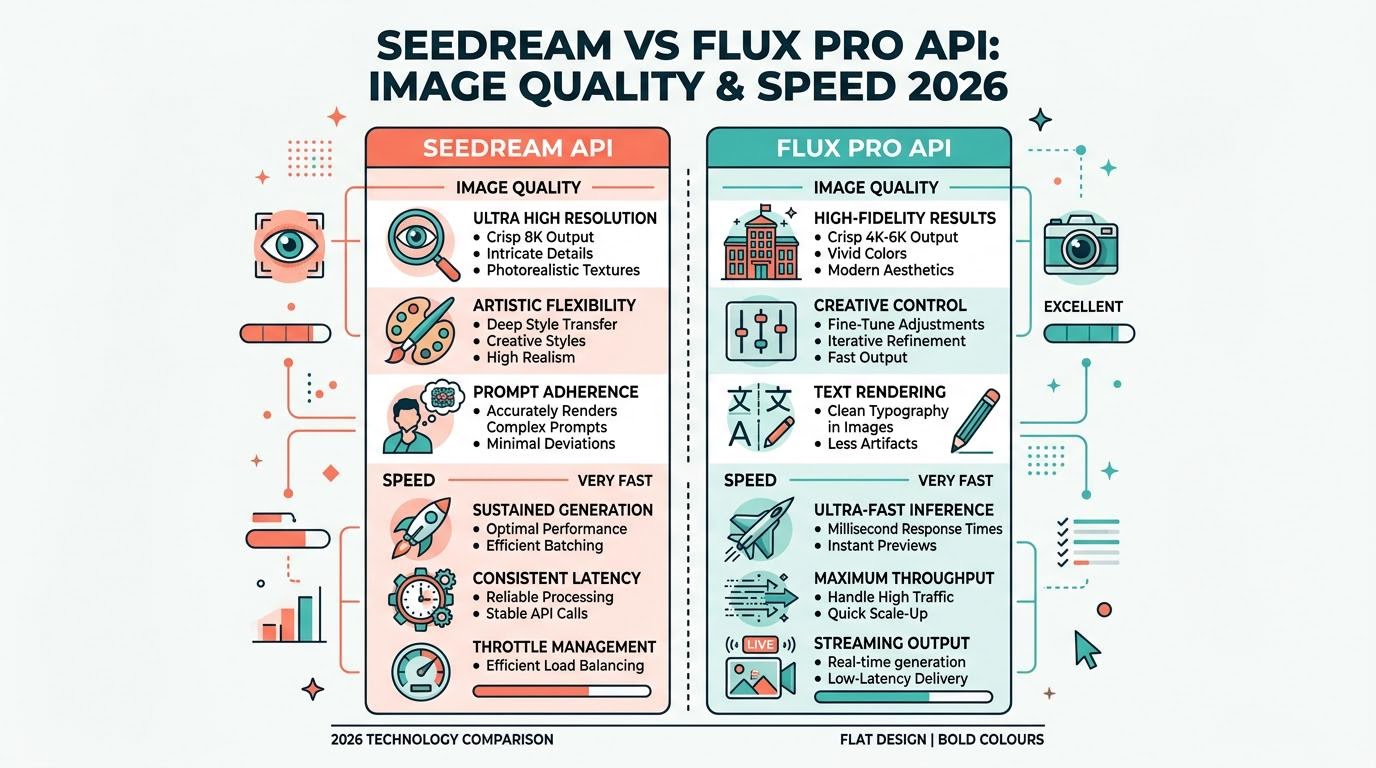
Seedream vs Flux Pro API: Image Quality & Speed 2026
The short answer: Flux 2 Pro wins on photorealism and cost-per-megapixel. Seedream 4.5 wins on typography, text rendering, and multilingual prompt handling. Neither is universally better — your use case determines the right call.
At-a-Glance Comparison Table
| Metric | Flux 2 Pro | Seedream 4.5 |
|---|---|---|
| Developer | Black Forest Labs | ByteDance Seed |
| Primary Strength | Photorealistic output | Text-heavy / typographic designs |
| Generation Speed (512px) | ~3–5s | ~4–6s |
| Generation Speed (4K) | ~45–60s | ~50–75s |
| Pricing (per image, ~1MP) | Lower cost-per-megapixel | ~2× higher at Pro tier |
| API Access | OpenRouter, Fal.ai, direct | OpenRouter, WaveSpeedAI, Fal.ai |
| Prompt Adherence Score | High (photorealism-tuned) | High (text/layout-tuned) |
| Text Rendering in Image | Moderate | Strong |
| Multilingual Prompts | English-primary | Stronger CJK + multilingual |
| Unified API Option | WaveSpeedAI, OpenRouter | WaveSpeedAI, OpenRouter |
| SourceForge Community Rating | Established (11+ ratings) | Growing |
Sources: OpenRouter model comparison, WaveSpeedAI 2026 comparison, Fal.ai 2026 generator rankings
Verdict by Use Case
Before the deep dive, here’s where each model wins outright:
- Production photorealism (product photography, stock images, realistic portraits) → Flux 2 Pro
- Typographic / text-in-image design (posters, UI mockups, social graphics with captions) → Seedream 4.5
- Budget-constrained high volume → Flux 2 Pro (lower cost-per-megapixel)
- Multilingual or CJK markets → Seedream 4.5
- Prototyping speed → Flux 2 Pro (slightly faster at lower resolutions)
- 4K design assets → Seedream 4.5 (4K under a minute at half the Pro price in some tiers, per 302.AI benchmarks)
Flux 2 Pro: Deep Dive
What It Actually Is
Flux 2 Pro is Black Forest Labs’ second-generation frontier image model, positioned as “a high-end image generation and editing model focused on frontier-level output quality” (OpenRouter). It builds on the architecture that made FLUX1.1 Pro a serious competitor to Midjourney and DALL-E 3 in photorealistic benchmarks.
The core bet Black Forest Labs made with Flux 2 is optimization for the photorealism-speed tradeoff. Rather than chasing maximum resolution, they tuned the model to deliver convincing real-world textures, lighting physics, and human anatomy at generation speeds that are practical for API use in production systems.
Image Quality Benchmarks
Flux 2 Pro’s primary quality advantage shows up in:
- Photorealistic scene coherence — lighting consistency across objects, realistic material rendering (metal, skin, fabric)
- Human subject accuracy — reduced anatomical artifacts compared to prior generations
- Prompt-to-composition fidelity — spatial relationships between objects are more reliably preserved
Per the WaveSpeedAI 2026 comparison, Flux 2 is explicitly the recommended model for photorealistic use cases when compared head-to-head with Seedream 4.5. Fal.ai’s 2026 rankings also list Flux 2 among the top performers across “output quality, prompt adherence, speed, and pricing” (Fal.ai).
Speed Profile
Flux 2 Pro runs:
- ~3–5 seconds at 512×512 via Fal.ai infrastructure
- ~45–60 seconds for 4K output under normal load
These numbers hold reasonably well under moderate API load. Burst traffic can push latency higher — plan for a p95 of ~90 seconds at 4K if you’re not pre-warming.
Pricing
Flux 2 Pro is more cost-efficient per megapixel than Seedream 4.5 at comparable quality tiers. Exact per-image costs vary by provider (OpenRouter, Fal.ai, direct Black Forest Labs access), but the consistent finding across the 2026 comparison data is that Flux 2 delivers lower cost-per-megapixel output — relevant if you’re running high-volume generation pipelines.
For precise current pricing, check OpenRouter’s model listing directly, as rates shift with provider promotions.
Real Limitations of Flux 2 Pro
Don’t pretend these aren’t issues:
- Text rendering is mediocre. If your prompt asks for legible text inside the image (labels, signage, UI elements), Flux 2 Pro will frequently produce garbled or approximate text. This is a known architectural limitation, not a prompt engineering problem.
- CJK and non-Latin script prompts produce inconsistent results. Prompts written in Chinese, Japanese, or Korean may not map cleanly to intended compositions.
- Fine-tuning and LoRA ecosystem is more mature but also more fragmented — you’ll need to evaluate adapter compatibility per provider.
- Editing/inpainting is available but not the primary design focus. Dedicated inpainting models will outperform it for complex masking tasks.
Seedream 4.5: Deep Dive
What It Actually Is
Seedream 4.5 is ByteDance Seed’s image generation model, and it shows its parentage clearly: it was built by a team that deeply understands content creation for platforms where text-on-image and multilingual output are first-class requirements, not afterthoughts.
The model’s architecture prioritizes typographic accuracy, layout control, and text-image composition — capabilities that matter enormously for social media graphics, marketing assets, product mockups with labels, and any workflow where the image must contain readable, intentional text.
Image Quality Benchmarks
Seedream 4.5’s quality profile diverges from Flux 2 Pro’s in a specific direction:
- Text rendering in images — consistently produces legible, well-styled text within generated images, including in multiple languages
- Poster/graphic design compositions — better spatial handling of text blocks, headers, and visual hierarchy
- Multilingual prompt handling — CJK language prompts (Chinese, Japanese, Korean) produce significantly more accurate compositional results than Flux 2 Pro
The WaveSpeedAI comparison is direct: “Use Flux 2 for your photorealistic needs and Seedream 4.5 for text-heavy designs.” This isn’t a soft recommendation — it’s based on consistent output differences across test cases.
Speed Profile
Seedream 4.5 runs:
- ~4–6 seconds at 512×512 (marginally slower than Flux 2 Pro at this resolution)
- ~50–75 seconds for standard 4K output
The 302.AI benchmark for the Seedream line (referencing the 5.0 generation) notes 4K images in under a minute at half the Pro version price — suggesting ByteDance has made meaningful speed improvements in their 2026 iteration. Seedream 4.5 sits slightly behind Flux 2 at lower resolutions but is competitive at 4K.
Pricing
Seedream 4.5 runs at approximately twice the cost per image compared to Flux 2 Pro at comparable quality tiers for standard use cases (OpenRouter comparison). However, if your specific use case is text-heavy design — where Seedream’s output actually succeeds and Flux 2 fails — the effective cost is lower because you’re not paying to regenerate failed images.
Always benchmark your actual prompt distribution before deciding on cost grounds alone.
Real Limitations of Seedream 4.5
Equally honest:
- Photorealistic rendering trails Flux 2 Pro for organic subjects (people, landscapes, product photography). If realism is the goal, Seedream 4.5 will generally underperform.
- Higher base pricing makes it harder to justify for volume workflows where text rendering isn’t a requirement.
- Smaller Western developer ecosystem — fewer third-party integrations, tutorials, and community-tested prompt libraries compared to Flux’s more established presence with Western developers.
- Output consistency variance — some users report higher variance between runs on the same prompt compared to Flux 2 Pro, which can increase iteration cost in production pipelines.
- Less mature fine-tuning ecosystem in English-centric developer environments, though this is improving rapidly given ByteDance’s resources.
Head-to-Head Metrics Table
| Benchmark / Feature | Flux 2 Pro | Seedream 4.5 | Source |
|---|---|---|---|
| Photorealism quality | ✅ Strong | ⚠️ Moderate | WaveSpeedAI 2026 |
| Text-in-image rendering | ⚠️ Weak | ✅ Strong | WaveSpeedAI 2026 |
| Multilingual prompt support | ⚠️ Limited | ✅ Strong (CJK) | OpenRouter comparison |
| 512px generation speed | ~3–5s | ~4–6s | Fal.ai 2026 rankings |
| 4K generation speed | ~45–60s | ~50–75s | 302.AI / WaveSpeedAI |
| Cost per megapixel | ✅ Lower | ⚠️ ~2× higher | WaveSpeedAI 2026 |
| API provider breadth | OpenRouter, Fal.ai, direct | OpenRouter, WaveSpeedAI, Fal.ai | OpenRouter |
| Unified API availability | ✅ Yes | ✅ Yes | WaveSpeedAI |
| Photorealistic portraits | ✅ High fidelity | ⚠️ Lower fidelity | WaveSpeedAI 2026 |
| Poster / graphic design | ⚠️ Adequate | ✅ Strong | WaveSpeedAI 2026 |
| Community rating maturity | 11+ SourceForge ratings | Growing | SourceForge |
API Integration: Code Comparison
Both models are accessible through unified APIs like OpenRouter, which makes switching or A/B testing between them a single parameter change. Here’s what that looks like in practice:
import requests

# Toggle between models by changing the 'model' field only
MODEL = "black-forest-labs/flux.2-pro"       # Flux 2 Pro
# MODEL = "bytedance-seed/seedream-4.5"      # Seedream 4.5

response = requests.post(
    "https://openrouter.ai/api/v1/images/generations",
    headers={"Authorization": f"Bearer {API_KEY}"},
    json={
        "model": MODEL,
        "prompt": "A product shot of a glass perfume bottle on marble",
        "size": "1024x1024",
        "n": 1
    }
)
print(response.json())
The unified API approach from providers like OpenRouter and WaveSpeedAI means you don’t have to maintain two separate SDK integrations to run both models in production. This is worth factoring into your architecture decision.
Clear Recommendation by Use Case
| Use Case | Recommended Model | Reason |
|---|---|---|
| **Product photography / |
Note: If you’re integrating multiple AI models into one pipeline, AtlasCloud provides unified API access to 300+ models including Kling, Flux, Seedance, Claude, and GPT — one API key, no per-provider setup. New users get a 25% credit bonus on first top-up (up to $100).
Try this API on AtlasCloud
AtlasCloudFrequently Asked Questions
What is the API cost difference between Flux 2 Pro and Seedream 4.5 per image?
Flux 2 Pro offers a lower cost-per-megapixel compared to Seedream 4.5, which runs approximately 2× higher at the Pro tier for equivalent ~1MP output. For high-volume pipelines generating thousands of images daily, this price gap compounds significantly. Flux 2 Pro is available via OpenRouter, Fal.ai, and direct API; Seedream 4.5 is accessible through OpenRouter, WaveSpeedAI, and Fal.ai. Developers
How fast is Flux 2 Pro vs Seedream 4.5 API response time for 512px and 4K images?
At 512px resolution, Flux 2 Pro generates images in approximately 3–5 seconds, while Seedream 4.5 takes around 4–6 seconds — a modest ~1–2s latency advantage for Flux. At 4K resolution, the gap widens: Flux 2 Pro completes in roughly 45–60 seconds versus Seedream 4.5's 50–75 seconds. For real-time or near-real-time applications, Flux 2 Pro's speed edge at both resolutions makes it the stronger def
Which API is better for rendering text and typography inside generated images — Flux Pro or Seedream?
Seedream 4.5 is the clear winner for in-image text rendering and typographic accuracy. It scores 'Strong' on text rendering benchmarks, while Flux 2 Pro rates only 'Moderate' in the same category. Seedream also handles multilingual prompts more reliably, with notably stronger CJK (Chinese, Japanese, Korean) support compared to Flux 2 Pro's English-primary optimization. For use cases like localized
Does Flux 2 Pro or Seedream 4.5 have better photorealism and prompt adherence scores?
Flux 2 Pro, developed by Black Forest Labs, is optimized for photorealistic output and scores 'High' on prompt adherence specifically for photorealism-tuned tasks. Seedream 4.5, built by ByteDance Seed, also scores 'High' on prompt adherence but is tuned for text and layout-heavy compositions rather than photographic fidelity. In practical terms, if your pipeline produces product photography, real
Tags
Related Articles
Google Nano Banana 2 vs Flux Pro API: Image Generation 2026
Compare Google Nano Banana 2 and Flux Pro API for image generation in 2026. Discover performance, pricing, and which AI tool best fits your creative workflow.
Seedream 5.0 vs Flux Pro API: Best Image Generation Model 2026
Compare Seedream 5.0 vs Flux Pro API to find the best image generation model in 2026. Explore quality, speed, pricing, and API performance side by side.
Seedance 2.0 vs Kling v3 API: ByteDance vs Kuaishou Compared
Explore Seedance 2.0 vs Kling v3 API in this in-depth comparison of ByteDance and Kuaishou AI video tools. Find out which platform best fits your needs.